The D4 “Exit to the City”

2001-the-d4-exit-to-the-cityPutting a band in a car is a pretty ordinary music video trick, but with “Exit to the City”, Greg Page takes things to a whole nother level, mercilessly shoving the D4 into the back of a van.

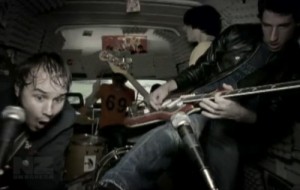
For a start there’s no green screen or trailer involved. It’s a real van driving through the streets of Auckland. And there’s no attempt to romanticise it as a road trip. There’s the band hunched over in the van, attempting to play the song while they’re hurled about as the vans takes corners. The outside – fairly ordinary looking streets of suburban Auckland – passively passes by the background windscreen.

The van is covered with egg cartons, presumedly to offer a bit of padding as the group is bumped around. But the pulpy protection starts to fall off, with large bits of the van’s bare metal interior exposed in some shots. This band suffers for their art.

The video is amusing, but it never goes for gags, rather letting the focus be the physical comedy of a band desperately trying to stay upright and rock out in a moving vehicle.

As well as the driver and the band, Greg Page is the sixth person in the band, crouched down below the camera, with his hand popping up to adjust a rogue microphone stand, hold up a pedal and finish with an “APPLAUSE” sign. I’m going to randomly declare this to be the most legendary of Greg Page’s videos.

Best bit: the disappearing and reappearing album cover.

Director: Greg Page
Ngā Taonga Sound & Vision

Next… a space odyssey.
The Black Seeds “Hey Son”

2001-black-seeds-hey-sonWellington’s finest purveyors of barbecue reggae have the first of their many NZOA-funded videos, after debuting with the self-funded “Keep on Pushing“. “Hey Son” is a fun one, of the “dressing up in crazy costumes and doing crazy things” type that Blerta pioneered back in the 1970s, or like an above-average 48Hours entry.
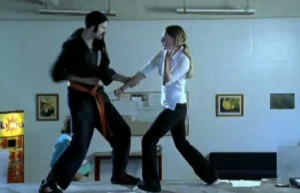
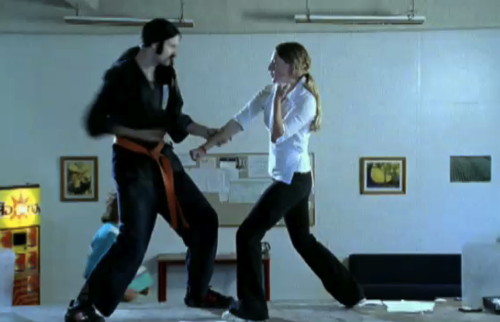
So, the Black Seeds have been charged with the offence of “civil unobedience” and have gone down to the office of The Man to sort out this problem. Only the long queues and unhelpful staff mean the only way things will get sorted is with a little comedic violence.

There’s running, jumping, firing soda cans from a vending machine, and use of a rubber stamp as a weapon. There’s also proper martial arts and the use of staple guns like pistols. And amid all this chaos, band member and future Grammy winner Bret McKenzie has a FIGWIT moment as a long-haired fellow in a Michael Jackson-style military jacket.

Meanwhile, Barnaby Weir has gone from smashing up a computer monitor to getting the band to smash up the mainframe. It’s not quite as epic as Dave killing HAL in “2001”, but it’s a lot more entertaining.

Back in the main office, a tardy courier has finally turned up with an official letter cancelling the infringement notice. “We hope this reaches you before you do anything drastic,” it says. I can’t help wonder if this crazy-arse bureaucracy actually wanted the Black Seeds to come and smash up its stuff.

While their later videos were more straight-up music videos, it’s cool to have this goofy adventure as the introduction to the Seeds.

Best bit: the furious rubber-stamp action – DENIED!

Director: James Barr
Ngā Taonga Sound & Vision

Next… a man with a van and a plan.

SJD “A Boy”

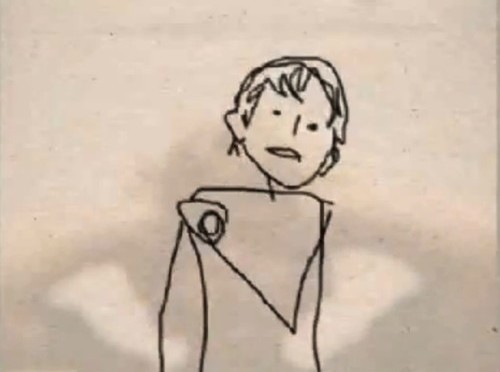
2001-sjd-a-boySJD’s second video starts with the song title scrawled across the screen in childish handwriting. Only it’s back to front, which automatically makes me think it’s a YouTube copyright takedown avoidance trick. Or maybe it’s just the writing of a kid who hasn’t learned to write left to right. I used to do that.

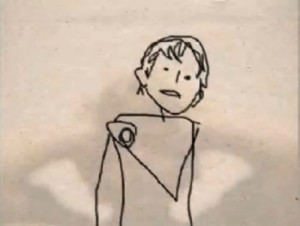
The handwriting turns into child-like drawings, stick figures with swords, giant rolling heads, morphing cats and other delights. Only the drawings are animated and have a sophisticated flow, suggesting it’s the work of someone who can draw properly.

Primitive stick figures joyfully run around, jumping through hoops. It’s weirdly alarming to see something as simple as a stick figure move so smoothly and naturally. It makes me feel quite inadequate about the quality of my attempts at stick figure.

Sometimes we see an eerie shadow looming over the screen. So who is behind this animation? It’s a boy, of course. We meet the (real, not animated) boy sitting at a desk in a strange CGI room. It seems all there is to do in the room is draw cartoons. And he’s not very happy. Well, with that experience he could always get a job at Weta Digital.

“A Boy” is a groovy number, but the video goes a bit darker (though the lyrics kind of match that tone). It doesn’t take the obvious video promo route, instead making something that is artistic in its own right. But that seems to be an SJD hallmark.

Best bit: the layers of dancing monsters.

Ngā Taonga Sound & Vision
Director: Kieran Donnelley, Dominic Taylor

Next… dem bones.

Anika Moa “Youthful”

2001-anika-moa-youthfulSo here’s Anika Moa. She’s had a lot of videos funded – at least 16, but possible more. “Youthful” was her first single of her poppy, New York-recorded debut album. Legend has it that her record company were trying to push her further down the pop route, but she went “nah” and took a step back to Aotearoa. It was a good move. “Youthful” was a hit for Anika, charting at #5 and getting the 2002 APRA award as the most performed work on New Zealand radio and television.

We meet the young Ms Moa (she was only 21) standing in the hallway of an ordinary looking house. She’s dressed very casually (denim jacket and bootled trousers) with scraggly Kim Deal-style hair and no noticeable make up. Hey, it’s Anika.

But from this ordinary scene she steps into a side room and is suddenly in a winter wonderland. It’s snowing and stands wearing an ice princess version of her streetwear casual style.

Off to the other side is an autumnal themed room, with the warm colours of deciduous leaves. And this time it’s dead leaves that are falling everywhere. A house with a tree in the middle of it seems a bit weird, until you consider that Korean restaurant on Queen Street that actually has a giant tree growing up in the middle of it.

But those seasonal rooms aren’t even the strangest. No, that belongs to the room with shelves full of mason jars with sheets of A4 flapping over each jar. With preserves being rather fashionable at the moment, it all looks like some sort of cool concept restaurant.

The song, with its themes of dominion and exploitation, has a sinister edge to it and the Paul Casserly-directed video goes with that uneasy vibe. I almost don’t want Anika to venture into the weird rooms, staying in the safety of the hallways, away from the mason jars and A4.

Best bit: the leaf that hits Anika on the side of the face.

Note: In one of C4’s Homegrown profiles from 2005, Anika talks about the making of this video. She chose the treatment out of several submitted, but felt that the lower budget of the video didn’t let it look as good as was originally intended. And people told her that she looked like Beth Heke. See more here, in part two.

Director: Paul Casserley
Ngā Taonga Sound & Vision

Next… the caravan of love.

Che Fu “Misty Frequencies”

2001-che-fu-misty-frequenciesIn the beginning there was Che Fu’s head. It pops up in a black void, before it’s suddenly revealed that Che and the nine members of his band are standing atop a strange brown platform. They discover that, oddly enough, they all have cables trailing from their backs and they can make musical sounds from their mouths. No one seems alarmed by this situation, and they excitedly plug their biocables into jacks.
Plugged in, the song starts with the sound graphing itself on the wall below the platform. Such is the power of the song that even unplugging it keeps the visual tricks going, with frequency graphics bouncing around the posse’s shirts.

The location is slowly revealing itself to be like a real-life video game, though with no apparent challenges, enemy to fight or princess to save. The gang throw Tetris blocks off the wall, then the wall turns into a Mario-inspired universe, with mushrooms and coins flying around. A flower pot appears and – obviously – Che plugs a cable into it. This transports the group to a real-life outdoor scene, some proper New Zealand bush.

The guys groove on, and are visited by one of the giant mushrooms from the earlier location. There’s no sign of Princess Peach. The video ends with the bush scene falling away in Tetris-like pieces, suggesting it’s no more real than the video game location.

The video feels like Che Fu, at the top of his game, making the music video he wants to make – and it was nominated for Best Video at the 2003 New Zealand Music Awards. It’s him and his mates reliving an ultimate childhood fantasy of exploring a video game for real. And maybe that’s the videos weakness – it feels a bit too much of “Hey, check out this cool shizz!” with little more to it. Unless I’ve overlooked a metaphorical commentary on the nature of the music industry.

Best bit: the pounamu piece smashing the Tetris blocks.

Director: Che Fu
Ngā Taonga Sound & Vision

Next… it’s great when you’re straight.

Steriogram “White Trash”

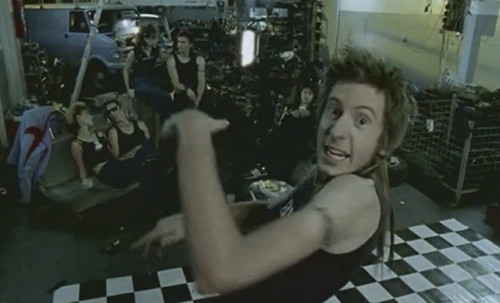
2001-steriogram-white-trashThis was “the video that started things off for us in New Zealand,” notes the Vimeo description. And indeed it was, with the sight of a skinny-arse, grease-covered, mulleted lead rapper Tyson kicking off the band’s burst of fame.
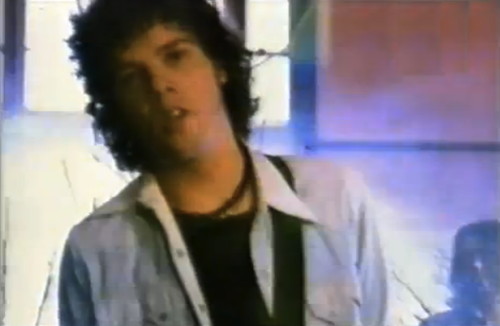
Tyson is in character as a hardcore westie/bogan type, with a hairdo reminiscent of Dave Spade’s “Joe Dirt” character. Being a mechanic, he’s covered in so much grease that I wonder if he’s some sort of holistic mechanic who fixes cars using his entire body.

The rest of the band arrived and with them are a couple of westie chicks. Tyson degreases and puts on his fancy going-out threads – a t-shirt reading “FAT AND PROUD”, which is funny because he’s only one of those.

Comedian and marriage celebrant Ewan Gilmour also joins the group, instantly attracting the attention of one of the chicks. That’s serious westie mana.

The video climaxes with some formation dancing, done with a similar ironic style that Fur Patrol did in “Andrew”. There’s something to be said when dance routines finally show up in New Zealand music videos, they’re done with tongue in cheek.

Steriogram’s videos have a lot of that cheeky spirit that forebears Supergroove had in abundance before they got all serious. The ‘Gram are happy to get all greased up and mulleted in the name of a fun video. And Ewan the Westie gets his girl.

Best bit: Tyson’s mullet preening.

Director: Adam Jones
Ngā Taonga Sound & Vision

Next… mighty morphin’ power popstars.

P-Money “Scribe 2001”

“Scribe 2001” was a P-Money track (and the opening track on his debut album) but the song was undeniably about the young rapper Scribe. The early 2000s were good for Scribe, the golden years before things started to get complicated. With P-Money’s sophisticated beats, “Scribe 2001” is an introduction to this fresh MC who had a way with words.

The video is incredibly low-budget and was made by P-Money himself. There’s even a brief shot of him reflected in a mirror as he films Scribe, holding the tiniest of video cameras. If P-Money is ever in the shot, the camera is stationary.

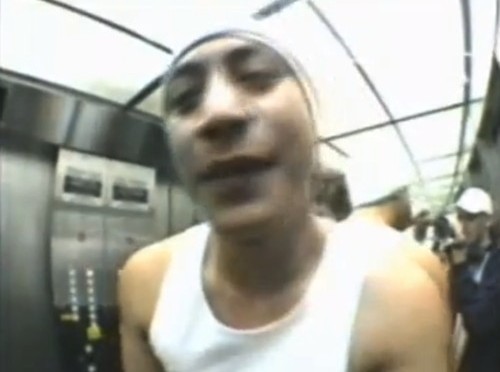
The video begins with the duo and pals in a car on a rainy afternoon. They have the freshly released CD single of the track and they blast it in the car stereo, relishing this moment of awesomeness. The video then has a quick montage of New Zealand music personalities of the era – there’s Otis and Slave, Jane Yee, DJ Sir-Vere and Che Fu. And then here’s Scribe telling us his story’s just begun, implying he’s the logical next step in that line-up.

The low-budget video camera gives everything a dull grey, washed-out look. Even Scribe and P-Money look less like a respected DJ and MC and more like a couple of friends mucking around with a video camera. But back then, that’s kind of what they were – a couple of dudes who knew they had a cool song that needed a video.

The video is totally lacking in glamour. They’re hanging around in a hotel room, by some lifts, in a stairwell, in a record shop. It’s a bland utilitarian landscape, brought to life by the killer track.

At one point Scribe is sitting at a table in a nondescript hotel room. In front of him is some cash. Not stacks of Benjamins, rather a more modest Hillary and a Queenie. P-Money flicks a 20 at the camera. The scene comes across as both a parody of hip-hop videos and the sincere swagger of two guys who know one day they’ll be able to do that in a fancy hotel suite and with big stacks of Rutherfords.

But whatever flaws the video might have, none of it really matters. The song is so strong that the video doesn’t need to be super slick. Hey, it’s Scribe and he has some rhymes for you.

Best bit: the people who share the lift with Scribe: frozen; horrified.

Director: Peter Waddams
Ngā Taonga Sound & Vision

Next… take out the trash.

Evermore “Oil & Water”

2001-evermore-oil-and-waterIt’s Evermore, the triple-bro guitar-pop group who’s had more success in Australia than New Zealand. “Oil & Water” was a track on the Hume brothers’ second EP (also titled “Oil & Water”) and it’s a pleasant enough song, but nothing remarkable.
The video takes the trio and puts them in an interesting old building full of bunches of twigs and pools of water. Or is that pools of oil? Either way, it’s not oil and water.

The lyrics are intent on using the oil and water not mixing as a metaphor to represent relationship tension. But oil and water aren’t all that bad. If it’s a petroleum-based oil, it can produce a cheerful rainbow. And add a few spices and herbs and you’ll have a delicious salad dressing.

Instead the video goes for a gothic tone. The brothers may be performing in front of a bright window, but they inhabit a world of stark silhouettes and those wintery twigs. It feels a bit post-grunge (is that a thing?), pulling away from the bright guitar pop of the late ’90s and bringing a bit of serious back.

Best bit: the awesome hair silhouettes, bringing an artful quality to a remnant of the hair metal days.

Bonus! Here’s a documentary on the 2000 Smokefreerockquest, where Evermore (aged 13-16) took out the big prize. Hugh Sundae also chats to other finalists Nesian Mystik and an early version of Die! Die! Die!

Next… the beginning of the story.

Ted Brown and the Italians “How is the Air up There?”

Ted Brown was (and still is!) a great songwriter and performer. I saw him opening for the Mutton Birds in 1993 and he blew everyone away. But yet chart success eluded him. His biggest hit was when the Strawpeople covered “Love Explodes”.

“How is the Air up There” was a 1966 hit for garage rock locals the La De Das. Ted and his Italians keep the crunch of the La De Da’s original version but give it a bit of jangle and some smoothness.

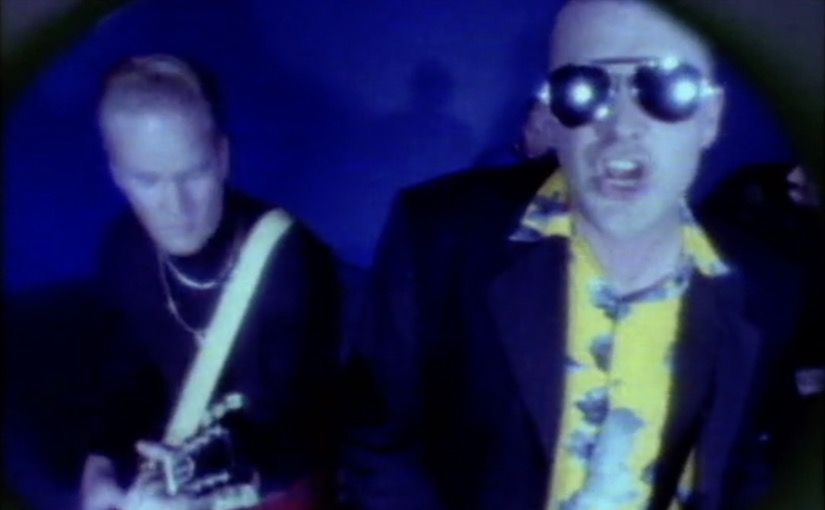
The video has hints of the psychedelic world of the ’60s. The band perform the song against a blue studio background, lit in red. It comes across a little sinister and menacing, with the shadows and red light looking like all that’s missing is a pitchfork and stick-on devil ears.

We also see the band in a more civilian form, shot in colour within a slightly psychedelic oval frame, with Ted in bad-ass mirror glasses. Maybe that’s the problem. The video seems a bit too badass. It’s sarcastic, sneering, aggressive. It’s a great song but the video feels like Ted is angry at me and I don’t like that feeling.

Best bit: Ted’s impeccable pronunciation of “air” and “there”.

Note: in 1995 a DLT remix of the song was used as the theme music for TV3’s New Zealand music show “Frenzy”.

Director: Craig Jackson
Ngā Taonga Sound & Vision

Next… a stylish collection of freaky friends.

Second Child “Crumble”

Second Child was the early band of Damien Binder, also featuring future Stellar guitarist Chris van de Geer. But the video strongly focuses on frontman Damien, to the point where it could easily pass for a solo video.

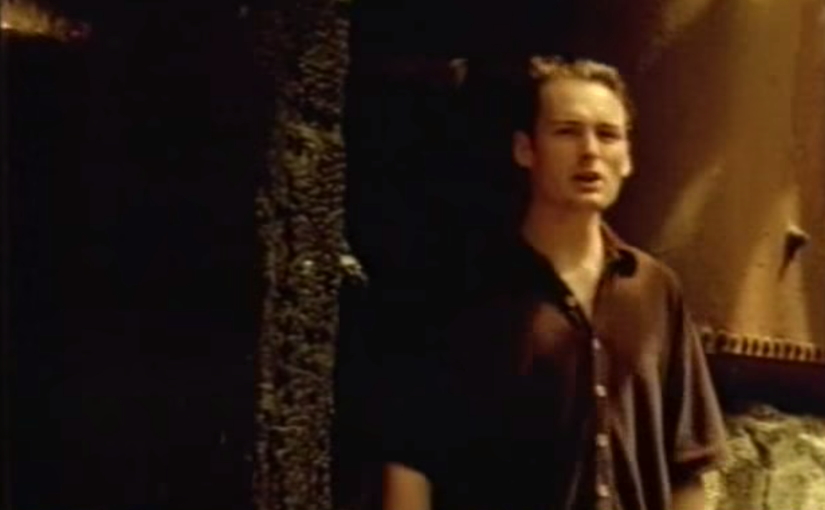
“Crumble” has a dark grungy sound, a song of bitter defiance. The video, directed by Jonathan King, is shot in sepiatone, filmed in an old rusty building. The lighting is dramatic, giving Damien plenty of opportunities to pout and sneer his way through the lyrics.

When we see the band, it’s only briefly and they’re left lurking in the shadows, a distant blur. But given that the song is about someone who’s succeeded against expectation, perhaps it’s better that the emphasis is on Damien, the man alone.

It’s a really good-looking video – something that I’ve come to recognise as a hallmark of director Jonathan King. He has an eye for sophisticated, artistic mise-en-scene. (OMG, I just used “mise-en-scene”. Well, I have to put my tertiary education to use.)

Best bit: the awesome setting for the guitar solo – a grungy concrete platform.

Director: Jonathan King
Ngā Taonga Sound & Vision

Next… a weather report.